

CFA® Level I formula sheet
Key formulas from EduFite's Level I lessons, grouped by topic. Free to read and search.
Studying for Level II? See the Level II formula sheet.
Get the full Formula Guide (PDF)
All 202 formulas on this page, explained: what each one tells you, when to use it, worked examples and the mistake to avoid. Free, with a short series of study emails, then one study note a month.
We use your email to send a short series of free study emails, then one study note a month, which may include offers for EduFite paid plans. Every email has an unsubscribe link. Privacy Policy.
202 formulas
Quantitative Methods
- Total return: income or distribution received in the period
- Arithmetic mean return
- Geometric mean return
- Effective annual rate: stated annual rate; : compounding periods per year
- Continuously compounded return: holding period return
- Real return
- Leveraged portfolio return: debt to equity; : borrowing cost
- Annualizing a short-period returndays: length of the holding period
- Domestic currency return, foreign asset: change in the foreign currency's value
- Time-weighted return: return of each one-year subperiod
- Money-weighted returnthe IRR of all cash flows into and out of the portfolio
- Coupon bond price: coupon; : face value; : periods to maturity
- Level payment on amortizing loan
- Implied one-year forward rate: one-year rate starting one year from now
- Sample variance and standard deviation
- Target semideviation: target return; sum only observations at or below
- Coefficient of variationrisk per unit of mean return
- Covariancepopulation form; the sample form divides by n - 1
- Correlation coefficient
- Binomial mean and variance: number of trials; : probability of success
- Total probability rule: mutually exclusive, exhaustive scenarios
- Bayes' formula
- Standard error of sample mean: population standard deviation; use when unknown
- Confidence interval for the meanpopulation standard deviation known
- t-statistic for a mean
- Chi-square test of variance: hypothesized variance;
- F-test for equal varianceslarger variance on top; : and
- t-test of a correlation: sample correlation;
- Chi-square test of independence, : observed and expected counts;
- Expected portfolio return: portfolio weights, summing to 1
- Two-asset portfolio variance
- Roy's safety-first ratio: minimum acceptable (threshold) return
- Scaling returns and volatility over timecontinuously compounded returns, independent periods
- Regression slope coefficientordinary least squares estimate
- Regression intercept
- Coefficient of determination: regression (explained) sum of squares
- Regression F-statisticone independent variable
- t-test of slope coefficient: hypothesized slope;
- Standard error of the forecastused to build the prediction interval
Economics
- Profit-maximizing output
- Marginal propensity to save
- Disposable income: tax rate
- Simple fiscal multiplierno taxes
- Fiscal multiplier with taxes: tax rate
- Neutral interest rate
- Trade balance and saving identityS - I: private saving less investment; T - G: fiscal balance
- Percentage change in exchange ratethe change in the base currency's value
- Absolute PPP exchange rate
- Real exchange rateS d/f: nominal spot, domestic currency per foreign unit
- Cross rate
- Bid and ask of inverted quote
- Forward rate from forward pointsdivisor usually 10,000 for four-decimal quotes
- Covered interest rate parityf/d: foreign currency units per one domestic unit
- Covered interest parity, short horizonDays: contract length; 360-day money market convention
Corporate Finance
- Total tax under double taxation: pre-tax earnings; , : corporate and dividend tax rates
- After-tax cost of debt
- Cash ratio
- Annualized cost of a loanincludes fees; Months: loan term
- Net present value
- Internal rate of returnthe discount rate that makes NPV zero
- Return on invested capital
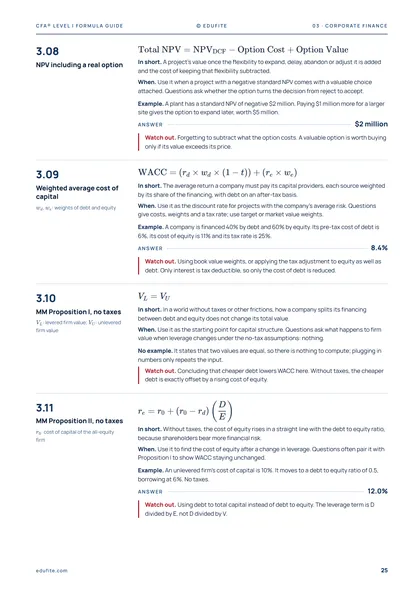
- NPV including a real option
- Weighted average cost of capital, : weights of debt and equity
- MM Proposition I, no taxes: levered firm value; : unlevered firm value
- MM Proposition II, no taxes: cost of capital of the all-equity firm
- MM Proposition I with taxes: value of the debt tax shield
- MM Proposition II with taxes
- Asset betaweighted average of debt and equity betas
- Static trade-off theory value
Financial Statement Analysis
- Basic EPS
- Diluted EPS, if-converted methodconvertible debt: add back the after-tax interest
- Diluted EPS, treasury stock methodoptions and warrants; shares repurchased at the average market price
- Goodwill: fair value of identifiable assets and liabilities
- Common-size balance sheet
- Current ratio
- Quick ratio
- Working capital
- Cash received from customersdirect method
- Cash paid to suppliersdirect method
- FCFF from net income: noncash charges; , : fixed and working capital investment
- FCFF from CFO
- FCFE from CFO
- Net realizable value
- Inventory turnover
- Days of inventory on hand
- FIFO inventory from LIFO
- FIFO COGS from LIFO
- Impairment loss, IFRSrecoverable: higher of fair value less selling costs and value in use
- Impairment loss, US GAAPonce undiscounted cash flows fall below the carrying amount
- Gain or loss on disposal
- Fixed asset turnover
- Average age of PP&E
- Lease ROU asset and liabilitylessee, initial measurement, both lease types
- Net pension liability or assetdefined benefit plans; : fair value of plan assets
- Income tax expense
- Deferred tax from temporary difference
- Receivables turnover and DSO
- Payables turnover and DOP
- Cash conversion cycle
- Debt-to-equity
- Financial leverage ratio
- Interest coverage
- Gross and net profit margin
- ROA and ROE
- DuPont ROE, three-part
- Purchasesthe numerator of payables turnover
- DuPont ROE, five-part
Equities
- Holding period return
- DCF intrinsic valueexpected cash flows plus terminal price, discounted at
- Residual income: required return on equity
- Gordon growth model
- Terminal value, multistage model: long-term stable growth rate
- Preferred stock valuenon-callable, non-convertible perpetual preferred
- Trailing P/E
- Forward P/E
- Justified trailing P/E
- Justified price-to-sales: net profit margin
- Dividend yield in Gordon model
- Herfindahl-Hirschman Index: market share of firm
- Blume adjusted beta
- Unlevered beta from comparables
- Relevered beta for the firm
- Country risk premium
Fixed Income
- Floating-rate coupon: market reference rate
- Repo initial margin
- Repo haircut
- Bond price from discount rate: market discount rate per period; solving for gives YTM
- Full price
- Accrued interest: days since the last coupon; : days in the coupon period
- Full price from last coupon date: price at the last coupon date
- Matrix pricing interpolationyield of a comparable bond, interpolated by maturity
- Periodicity conversion: annual rate compounded times per year
- Current yield
- Value of embedded call
- G-spread
- Z-spread pricing: government spot rates; : constant spread added
- Option-adjusted spreadcallable bond; for a putable bond, OAS is above the Z-spread
- FRN priceQM quoted margin, DM discount margin, m periods per year
- Discount rate (DR)money market basis for T-bills, commercial paper, bankers' acceptances
- Add-on rate (AOR)money market basis for CDs, repos, MRR indexes
- Bond equivalent yieldadd-on rate on a 365-day year
- Price using spot rates
- Par rate: par coupon per 100 of face value
- Implied forward rateforward rate for years, starting at year
- Duration gap
- Modified duration: yield per year; : periods per year
- Price change from modified duration
- Approximate modified duration, : prices after the yield falls and rises
- Money duration
- Price value of a basis pointprices for a 1 bp fall and rise in yield
- Price change with convexity
- Approximate convexity
- Money price change with convexity
- Money convexity
- Effective duration: parallel shift in the benchmark yield curve
- Effective convexity
- Price change, effective measuresfor bonds with embedded options
- Key rate duration: change in the par rate at maturity
- Expected loss
- Loss given default: expected exposure; : recovery rate
- Debt service coverage ratiorevenue bonds; NOI: revenue minus operating expenses
- Debt to EBITDA
Derivatives and Risk Management
- Forward value at maturity, long
- Forward value at maturity, short
- Call payoff at expiration
- Put payoff at expiration
- Forward price with carrycosts add to, benefits subtract from, the spot price
- FX forward priceS and F in foreign currency per unit of domestic
- Forward price, no carry
- Forward value before maturityvalue to the long at time ; no carry
- FRA payofflong FRA, settled at the start of the period
- Interest rate futures priceMRR as a decimal
- Basis point value (BPV)Period: days/360 of the underlying rate
- Swap fixed rate at inceptionthe fixed rate is set so the swap has zero value
- Put-call parityEuropean options; no income or costs on the underlying
- Put-call forward parity
- One-period binomial prices: up factor; : down factor
- Hedge ratio
- Hedged portfolio value
- Hedged portfolio earns risk-free rate
- Risk-neutral probability, : gross up and down factors
- Call value, risk-neutralexpected payoff discounted at the risk-free rate
Alternative Investments
- Multiple of invested capital (MOIC)
- Leveraged return: borrowed; : own capital; : borrowing cost
- Commodity futures price: storage cost; : convenience yield; continuous compounding
Portfolio Construction
- Required return decompositionreal risk-free rate, expected inflation, risk premium
- Investor utility: risk aversion coefficient
- Two-asset portfolio return
- Two-asset portfolio standard deviation
- Risk of a large portfolioaverage covariance dominates as grows
- Covariance from correlation
- Rule for adding a new assetadd the asset if its Sharpe ratio exceeds this threshold
- Capital market line
- Risk with a risk-free asset: weight in the risky portfolio
- Total risk decomposition
- Beta
- CAPM, security market line
- Sharpe ratio
- Treynor ratio
- Jensen's alpha
- NAV per share
- Pre-tax required return
Get the full Formula Guide (PDF)
All 202 formulas on this page, explained: what each one tells you, when to use it, worked examples and the mistake to avoid. Free, with a short series of study emails, then one study note a month.
We use your email to send a short series of free study emails, then one study note a month, which may include offers for EduFite paid plans. Every email has an unsubscribe link. Privacy Policy.
Your next step
Put the formulas to work
The exam gives you no formula sheet, so formulas stick best when you use them. Take the free 30-question Level I mini mock and see your score by topic, with no account needed.
Try the mini mockOr test yourself first with the free Level I flashcards.